Major Arcana Meanings: Quick Guide to All 22 Cards
Solaris Tarot · 15 April 2026 · 9 min
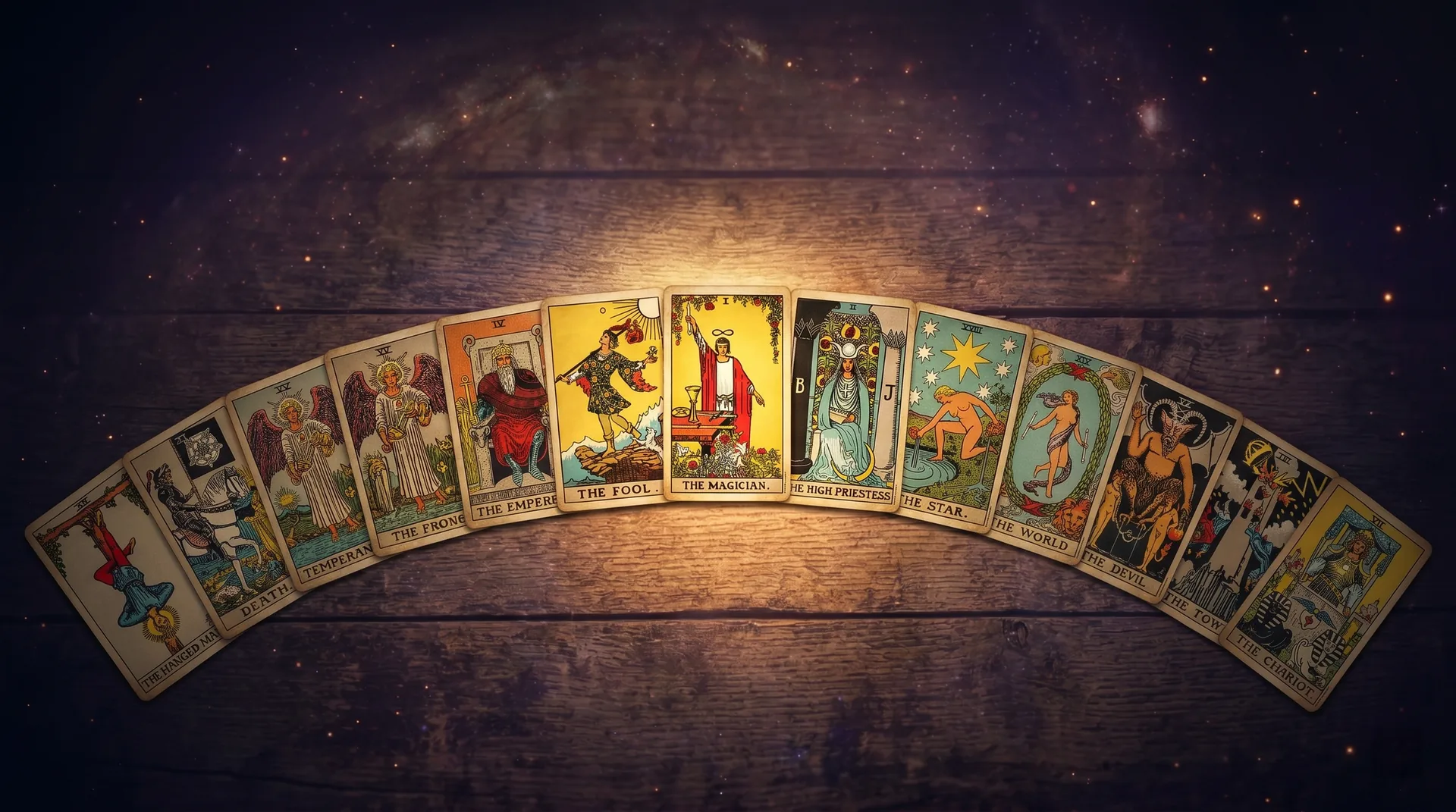
Learning the Major Arcana meanings is one of the first solid steps for anyone new to reading Tarot. These 22 cards hold the big themes of human experience: identity, love, fear, choice, loss, and renewal. When they show up in a spread, they usually set the main tone of the reading.
At Solaris Tarot we think of these cards not as fixed definitions to memorize, but as a symbolic vocabulary you learn to read in context. Each arcanum is a mirror where you can recognize a part of your own story.
This guide is a quick reference. Read it end to end for an overview, or come back whenever a specific card appears in one of your readings. To see every card illustrated, explore the full card catalog.
What the Major Arcana are
The Major Arcana are the 22 cards numbered 0 through 21 that form the symbolic core of any Tarot deck. Unlike the Minor Arcana, which describe everyday situations and emotional nuance, the Majors speak to archetypal themes: life transitions, deep lessons, and inner processes that most people move through in one form or another.
Traditionally, the 22 cards are said to tell a story known as "the Fool's journey." In that story, the Fool (card 0) sets out innocently on the road and meets figures and situations — the Magician, the High Priestess, the Empress, and so on — that represent stages of maturity. You do not have to believe in this journey literally for it to be useful: it works as a narrative map that gives the cards a shape.
When several Major Arcana appear in a single reading, we take it as a signal that the theme you are exploring carries real symbolic weight — it is not just a passing anecdote. When the Minors dominate instead, the situation is usually more concrete and day-to-day.
The 22 cards, one by one
Below you will find a short description of each arcanum: its central archetype, a primary meaning in the upright position, and an invitation to growth. Remember that Tarot does not predict fixed events; it offers readings that help you reflect.
0. The Fool
The Fool stands for the pure beginning, the moment when you take a step without guarantees but with trust. Its archetype is the novice traveler setting out with only the essentials. In a reading, it usually invites you to embrace what is new and to let go of the fear of having to figure everything out before you start.
1. The Magician
The Magician represents the capacity to turn intention into action. The elements laid out on the table are already his, and he knows how to combine them. When this card appears, it reminds you that you already have the resources you need to move forward; the invitation is to use them with focus, instead of waiting for perfect conditions.
2. The High Priestess
The High Priestess is the guardian of inner knowledge and of what has not yet been spoken. She represents trained intuition and fertile silence. Her main message is to pause before acting: there is important information inside you or around you that has not fully surfaced, and it is worth listening for.
3. The Empress
The Empress embodies fertility, care, and creation in a broad sense: projects, relationships, body, home. Her archetype is maternal without being restrictive. When she appears, she may be pointing to an area where something is growing strongly in your life, and inviting you to nourish it with time and conscious attention.
4. The Emperor
The Emperor represents structure, healthy authority, and the ability to bring order. This is not about rigidity, but about creating a framework in which things can hold up over time. His invitation is to look at which boundaries, routines, or agreements you may need so that your projects stop depending purely on momentum.
5. The Hierophant
The Hierophant symbolizes tradition, teachers, and shared frameworks of meaning. He can show up as an institution, a mentor figure, or a set of inherited values. His message is not to obey without thinking, but to ask yourself which outside teachings still hold you up — and which ones you sense are ready to be revisited or updated.
6. The Lovers
The Lovers go beyond romance: they represent deep choices where your values are on the line. They often involve a decision between two paths that are not equivalent. The invitation is to choose from what truly matters to you, not from what is more comfortable or what other people expect.
7. The Chariot
The Chariot stands for directed momentum and the will that keeps moving despite opposing forces. For the chariot to reach its destination, the driver has to hold the reins firmly. When it appears, it invites you to focus your energy in a clear direction and not let conflicting impulses push you forward and back without a destination.
8. Strength
Strength represents a calm kind of power: the kind that tames the lion through patience, not violence. It speaks of inner courage, emotional steadiness, and trust in your own ability to hold what is hard. Its invitation is to respond to challenges from active calm, rather than from fear or force.
9. The Hermit
The Hermit is the figure who withdraws to light his lantern. He symbolizes the inner search, deliberate silence, and the kind of wisdom that only arrives when you slow down. If he shows up in your reading, he is probably inviting you to spend some time alone with your questions, without rushing to answer them.
10. Wheel of Fortune
The Wheel of Fortune speaks of cycles and changes that are not fully under your control. Sometimes the wheel rises, sometimes it falls. Its message is not resignation, but recognizing which part of the current moment is circumstance and which part you can still meet with a conscious decision.
11. Justice
Justice symbolizes the balance between action and consequence, and honesty with yourself. She holds scales and a sword: she weighs and she discerns. When she appears, she invites you to look at whether there is something you want to repair, an agreement to renegotiate, or a truth you have not yet dared to name out loud.
12. The Hanged Man
The Hanged Man represents pause, surrender, and a shift in perspective. He hangs upside down by choice, not as punishment. His invitation is to loosen your grip for a moment and accept that, sometimes, the way out only appears when you see things from a different angle. He can mark a stage of fertile waiting, not a sterile one.
13. Death
Death is one of the most misunderstood cards. It does not announce a physical passing, but a necessary ending: a chapter, a bond, an identity. Its invitation is to let go of what can no longer travel with you so that something new finds room. Ending and beginning are the same doorway.
14. Temperance
Temperance represents integration and careful blending. An angel pours water between two cups without spilling a drop. It speaks of finding the middle point between extremes, of combining parts of you that seemed incompatible. Its invitation is to seek balance without flattening your nuances, and to moderate without giving up what is essential.
15. The Devil
The Devil stands for the chains we accept without noticing: attachments, dependencies, fears that no longer serve us. It is not a card of condemnation, but of awareness. The figures tied to the base could slip the chains if they decided to. It invites you to look at what you keep out of habit rather than out of real choice.
16. The Tower
The Tower represents the sudden collapse of structures that were no longer solid. It can hurt and disorient, but more often than not it also frees. Its message is to accept that when something built on fragile ground falls, the space that opens up lets you rebuild on more honest terrain.
17. The Star
The Star brings calm hope after the storm. A figure pours water onto the earth and into the pond at once: she renews and she shares. Her message is that, even after a hard blow, you can trust again, rehydrate your motivation, and look up at the sky without cynicism. It is a card of restorative calm.
18. The Moon
The Moon speaks to what is not seen clearly: dreams, intuitions, blurry fears, incomplete information. It does not necessarily mean deception, but it does invite you to avoid making final decisions in places where there is still fog. Sometimes you have to walk without knowing everything, with your senses fully awake.
19. The Sun
The Sun represents vitality, clarity, and legitimate joy. It is one of the brightest cards in the deck: it marks moments where something becomes visible with real sharpness and you are allowed to celebrate it without qualifications. Its invitation is to let yourself enjoy what is working openly, without feeling you need to shrink it or hide it.
20. Judgement
Judgement stands for an inner call to review your story and respond with awareness. It does not judge you from the outside: it asks you what you want to acknowledge, forgive, or pick back up. Its invitation is to integrate what you have lived honestly, to make choices more aligned with who you are now, and to step toward a more mature version of yourself.
21. The World
The World closes the Fool's journey with a sense of wholeness and integration. It represents a completed cycle, an accomplishment that feels whole. It does not mean there is nothing left to do: it marks a threshold worth recognizing before you start again, with more awareness, in the next chapter.
How to use this guide in your practice
We suggest treating this page as a reference point, not as a closed oracle. When a card shows up in your reading, come back, read its entry, and ask yourself how it resonates with the specific situation you are exploring. Meaning shifts with the question, the position in the spread, and the other cards on the table.
A useful practice for beginners is to draw one card a day, read its entry in this guide, and notice throughout the day whether anything from the archetype is reflected in what you live. You do not need to force coincidences; it is enough to keep your eyes open.
If one card intrigues you in particular, open its dedicated page from the links above: there you will find more detail on its symbols, variants, and nuances. And if you want to see how they behave together, you can draw a spread with us and watch how they speak to each other.
Tarot works best when it does not ask you to believe more than you want to, or less than the moment calls for. It is a tool for reflection, and the Major Arcana are its biggest questions.
Tarot on Solaris Tarot is a tool for reflection and entertainment. It does not substitute for professional medical, legal, financial, or psychological advice.
Want to explore a card in depth? Start a reading on Solaris Tarot →
Ready for your first reading?
Get started